
Notice Writing: Format, Samples and Questions ICSE English
- Date
Notice writing is one of the most rewarding sections of the ICSE English Language paper. A notice typically carries 5 marks, and because it follows a fixed, predictable pattern, it is one of the easiest places to secure full marks once you know the format. Master the structure once and you can apply it to almost any event your school might announce.
A notice is a short, formal piece of writing used to inform a large group of people about an event, an instruction or a change. In school it is usually issued by the Head Boy, the Head Girl, a club secretary or a teacher-in-charge. Let us go through everything you need to write a clear, mark-worthy notice for your ICSE exam.
What is Notice Writing and Why is it Important in ICSE?
A notice is a formal announcement displayed on a notice board to communicate the same information to many people at once. Since everyone reads the very same words, a notice has to be accurate, brief and unambiguous: there is no room for a chatty, personal or emotional tone.
Notice writing appears in the ICSE syllabus because it tests a genuinely practical skill: presenting essential information in a tight, organised format.
A good notice quietly answers the reader’s natural questions, what is happening, when, where and how to take part, without a single wasted word. Students learn to be precise, to respect a word limit and to keep their writing formal and impersonal, all of which are useful well beyond the exam hall.
Notice Writing Format: A Step-by-Step Guide for ICSE Students

Download Notice Writing Format ICSE PDF
A notice is centrally aligned and is never enclosed in a box. Each piece of information sits on its own centred line, building a neat, poster-like announcement from the title down to the venue. Here is what each line must contain, along with the marks it carries:
- Creative title (1 mark): A short, catchy title of 2–3 words only, written in English. It should capture the spirit of the event but must not repeat any word from the question. For a debate, “War of Words” works nicely.
- Event title (1 mark): The actual name of the event, with an extra detail such as the edition, year or scope. For example “Annual”, “First Edition” or “Inter-School”. This is where you state plainly what is being announced.
- Date (½ mark): The date of the event, written as day, month and year. It should fall 10–14 days after the date of the exam, so people have enough time to prepare.
- Time (½ mark): The timing of the event, for example “from 9:00 a.m. to 12 noon”.
- Venue (½ + ½ mark): Name the place at two levels: the specific spot and the larger location it sits within, for example “Subhash Hall, Bright High School”.
- The three essentials (1 mark): Close the notice with one sentence that states three things, who may take part (which classes or target audience), with whom to register, and the last date to register. The registration deadline should fall 2–3 days after the exam date.
A Quick Note on Dates:
The exam paper never gives you a “today’s date”, so use the date of the exam as your reference point. Set the event 10–14 days after it and close registration 2–3 days after it.
This keeps every date realistic and consistent.
Get Personalized Tuitions
We offer premium education on a personalized level. Online tuition for all grades, tailor-made!

Writing Tips to Score Full Marks in ICSE Notice Writing
Here are the common slips to avoid, with quick examples:
- Do not draw a box. ICSE notices are centrally aligned on the page with no border around them. A box is a different (CBSE-style) convention and is not expected here.
- Keep the creative title to 2–3 words and original. It must not borrow any word from the question.
Weak: “Debate Competition” — copies the topic.
Better: “War of Words” — creative and only three words. - Peg your dates to the exam date. Set the event 10–14 days after the exam and close registration 2–3 days after it, so the gaps make sense.
- Never miss the three essentials. The closing sentence must name the eligible classes or audience, the person to register with, and the last date to register. Dropping any one of these costs you the mark.
- Stay formal and impersonal. A notice is not a letter. So leave out greetings like “Dear students”, personal sign-offs and chatty sentences. Keep every line factual.
- Centre every line. Each item sits on its own centred line, building the announcement neatly from the title to the venue.
Avoiding these pitfalls will keep your notice clean, complete and easy to mark.
Example and Practice Notice for ICSE Students
Here is a fully worked example, a second solved notice, and a few questions to practise on.
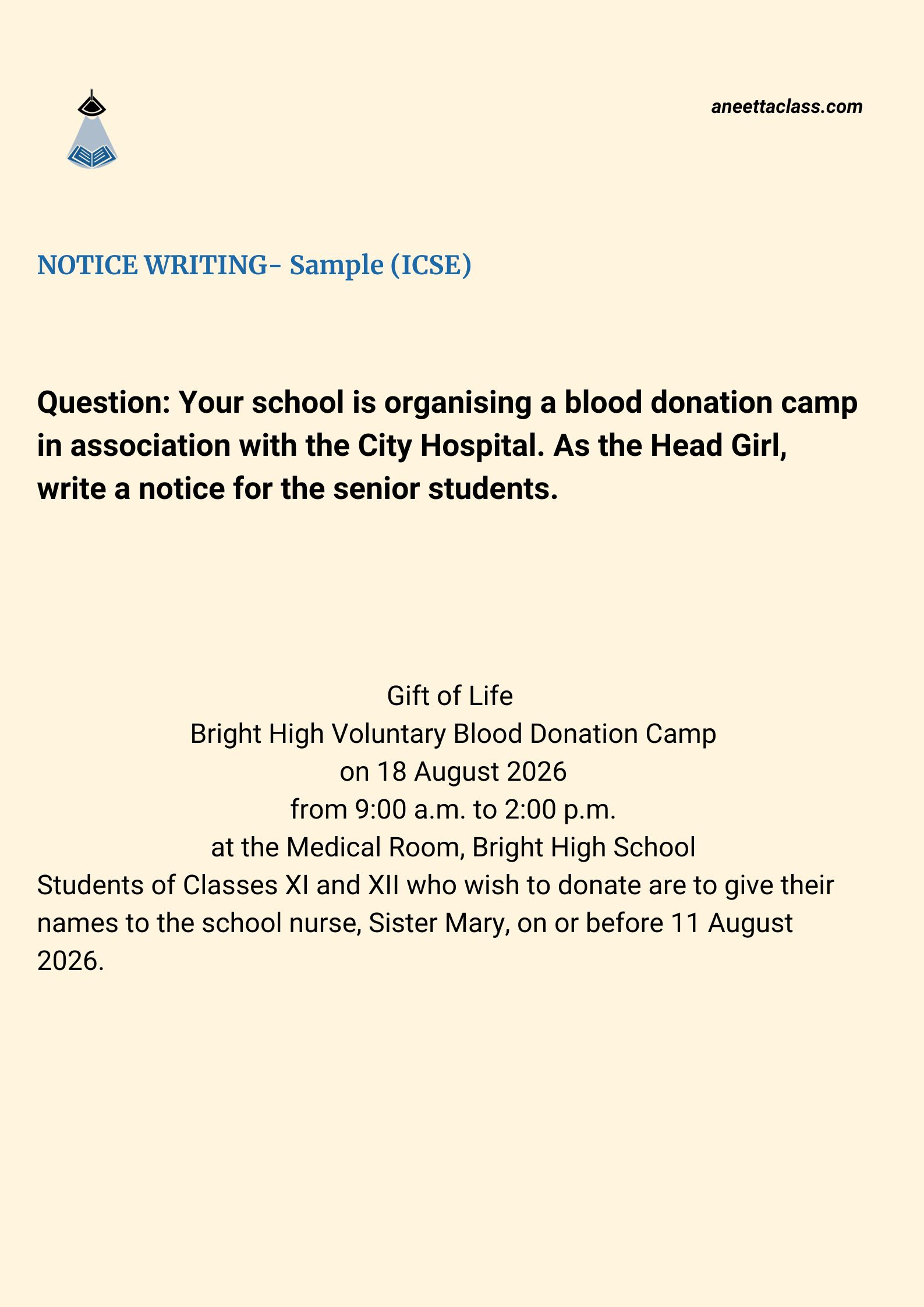
Download Notice Writing Sample ICSE PDF
Example 1: Your school is hosting an inter-school debate competition. Write a notice for your school informing them of the event.
(Centre-align every line below; do not put a box around it.)
War of Words
Bright High Inter-School Debate Competition
on 25 July 2026
from 9:00 a.m. to 12 noon
at Subhash Hall, Bright High School
Pupils from Classes IX and X who wish to participate are to give their names to Mrs N. Sharma on or before 18 July 2026.
Example 2: Your school is organising a Poster Making and Slogan Writing Competition on the occasion of World Environment Day. As the Secretary of the ‘Environment Club’, write a notice asking students of Classes VI to X to submit their entries.
Green Strokes
World Environment Day Poster Making and Slogan Writing Competition
on 28 July 2026
from 9:00 a.m. to 11:00 a.m.
at the Senior Art Room, Bright High School
Students of Classes VI to X who wish to take part may submit their entries to the Secretary, Environment Club, on or before 21 July 2026.
Practise Notice Writing Questions:
- Your school’s Music Club is holding an inter-house singing competition. As the Club Secretary, write a notice inviting entries.
- The school library is starting a Book Club and needs new members. As the Head Girl or Head Boy, write a notice about it.
- Your school is organising an Annual Science Exhibition. Write a notice informing students of the date, time and venue.
Practising with examples like these will steadily build your confidence. Try writing each one out in full, then check it against the format above.
Keep Writing
When you sit down to write a notice, keep three words in mind: brief, clear and centred. Every line should give the reader exactly one piece of information, with nothing repeated or padded.
Practise with the questions above, check your dates against the exam-date rule, and proofread for any stray informal lines. With a little consistency, notice writing will become one of the most reliable sources of full marks in your ICSE English Language paper.
If you need any help in learning ICSE English Language and Literature reach out to us!